I walk through the gardens a couple times a day. I look for dead stuff, wilty stuff, unhealthy stuff, and pests. I notice what’s blooming and what’s past its prime. And, I look for buds of new growth. But, yesterday, I walked through and noticed the gardens as a whole, and I noticed that the garden completely lacks red! There’s not one speck of true red in any of the gardens this time of year!
I avoided true reds close to the house because of the barn red trim, but hadn’t realized that I had omitted red everywhere until yesterday. I have red tulips, red poppies, and one red monarda—otherwise, no red. The lilies, Monte Negro, are in the red family, but aren’t a true red. Neither are the Knautia Macedonia (more wine colored) or the Lychnis chalcedonia (leaning orange). Both of these, however, are on several lists of “Red Perennials.” A friend suggested a rose. I could do that. I’d need to move a wild rose to a partly shady spot to do it, but it’s a possibility. Is lobelia really my only non-rose perennial option?!
Maybe the way to get some red into the gardens is to get a few planters and fill them with red geraniums and impatiens, like my grandmother and father have done for years. They’re long blooming and do provide a big impact.
Let me know how you get red in your gardens.
Showing posts with label monarda. Show all posts
Showing posts with label monarda. Show all posts
Tuesday, August 3, 2010

Wednesday, July 28, 2010
Note to Self
Typically when I say this phrase, it’s because I want to remind myself of something I don’t want to repeat, like “Note to self, don’t plant all 6 zucchinis that come in the 6 pack.” (Why do they even sell zucchinis in 6 packs?) Or, “Note to self, sitting at a Little League double header in the midday sun with no sunscreen is a bad idea.”
But, I was talking with a colleague the other day, and she was taking notes about what she wanted to repeat in her veggie garden next year! And, she’s keeping notes now instead of at the end of the season, which is when I typically take stock of what went well and what didn’t go so well in my own gardens.
So, I decided to give it a try. I found a notebook, plopped myself in the Adirondack chair, and took some notes about what I wanted to repeat (and not repeat) next year. Here are a few things on the list:
Does anybody else keep a notebook during the growing season about what they want to repeat next year? If so, what's on your list?
But, I was talking with a colleague the other day, and she was taking notes about what she wanted to repeat in her veggie garden next year! And, she’s keeping notes now instead of at the end of the season, which is when I typically take stock of what went well and what didn’t go so well in my own gardens.
So, I decided to give it a try. I found a notebook, plopped myself in the Adirondack chair, and took some notes about what I wanted to repeat (and not repeat) next year. Here are a few things on the list:
- Plant more tomatoes—and plant them in the rose garden. I planted tomatoes in pots this year to give the spot in the veggie garden a rest and they are bearing, but not abundantly. The potted tomatoes are in the rose garden now, and they like it.
- Plant squash and cucumbers. I love cucumbers and squash and didn’t plant either this year. What was I thinking?!
- Plant more monarda and ratibida. I saw a stand of monarda earlier this year in a variety of colors and heights and really want to give something like that a whirl. And, I fell in love with the tall delicate ratibida this year and want to put it in a couple more gardens.
- Build a screen for the front walk garden. The front walk curves around the side of the house and the garden ends at the curve. But, you can see all the way to the compost bin and a decorative screen would prevent that and keep the focus on the garden.
Does anybody else keep a notebook during the growing season about what they want to repeat next year? If so, what's on your list?
Tuesday, July 20, 2010
Images of Grass and the Prairie
I’ve been thinking about grass and grasses this summer—lawns and prairies—ornamentals and natives. I’m not a huge fan of lawns. They’re a lot of work. And, there’s a lot of pressure to match your neighbor’s lawn height. People have told me that gardening is more work than a lawn, but when I see people on their hands and knees digging dandelions and pulling quack grass and crab grass and pieces of clover and violets, I think they’re wrong. In a garden, once pulled the weeds, you’re done! In a lawn, you still have to get out the mower.
When we planted the community garden, the city had not yet cut the grass on the knoll and it was between knee and thigh high. As I carried plants (and later buckets of water) from my car to the garden, I imagined pioneers in long pants and dresses walking along side covered wagons in grass of a similar height.
The view from my office overlooks a highway embankment and ramp. The embankment is covered with various grasses and prairie plants (monarda, ratibida, rudbeckia, oxeye daisies, bergamot, and knapweed). The colors and textures are mesmerizing some afternoons. The grass and plants are waist tall in places on the embankment. The same plants and grasses fill the fields on the way to the community garden by the office. The aroma from the grasses and wildflowers is intoxicating. I couldn’t imagine being a pioneer walking through grasses and flowers this tall. It would be almost like swimming in Jello – lots of effort.
A friend and her daughter just returned from DeSmet, South Dakota, where they were visiting the home of Laura Ingalls Wilder—complete with stay in a covered wagon. In one photo, the daughter is standing in a field of waist high wildflowers in period dress. It’s exactly what I had imagined.
When we planted the community garden, the city had not yet cut the grass on the knoll and it was between knee and thigh high. As I carried plants (and later buckets of water) from my car to the garden, I imagined pioneers in long pants and dresses walking along side covered wagons in grass of a similar height.
The view from my office overlooks a highway embankment and ramp. The embankment is covered with various grasses and prairie plants (monarda, ratibida, rudbeckia, oxeye daisies, bergamot, and knapweed). The colors and textures are mesmerizing some afternoons. The grass and plants are waist tall in places on the embankment. The same plants and grasses fill the fields on the way to the community garden by the office. The aroma from the grasses and wildflowers is intoxicating. I couldn’t imagine being a pioneer walking through grasses and flowers this tall. It would be almost like swimming in Jello – lots of effort.
A friend and her daughter just returned from DeSmet, South Dakota, where they were visiting the home of Laura Ingalls Wilder—complete with stay in a covered wagon. In one photo, the daughter is standing in a field of waist high wildflowers in period dress. It’s exactly what I had imagined.
Thursday, July 15, 2010
Garden Blogger's Bloom Day -- July 15
Last month, one of the garden blogs I follow mentioned Garden Bloggers Bloom Day. I was too late to participate last month, but can this month (and every 15th of the month during the growing season). The premise is to post photos of what’s blooming in the garden on this particular day. May Dreams Garden hosts, and provides a list of participating garden blogs.
 Here’s what’s blooming in Auntie K’s Garden today: One of my favorite monarda—Grand Marshall.
 The lovely and buttery Julia Child Rose
 These Lace Cap Hydrangea weren’t there when the house was built in 1916, but my understanding is that they went in shortly after that. They’ve come up every year since and try to creep into the path. I try to keep them in check. There are a few blooms left on the coreopsis, too.

 The volunteers in the garden this year include both this lovely cosmos (near the lamb’s ear) and the sunflower (courtesy of squirrels or birds from the feeders).

Most of the natives have started to pop, too: Purple Coneflower, White Swan Coneflower

Rudbeckia, Purple Garden Phlox, Russian Sage

And, my new favorite Ratibida with the Anise Hyssop.
 Here’s what’s blooming in Auntie K’s Garden today: One of my favorite monarda—Grand Marshall.
 The lovely and buttery Julia Child Rose
 These Lace Cap Hydrangea weren’t there when the house was built in 1916, but my understanding is that they went in shortly after that. They’ve come up every year since and try to creep into the path. I try to keep them in check. There are a few blooms left on the coreopsis, too.
 The volunteers in the garden this year include both this lovely cosmos (near the lamb’s ear) and the sunflower (courtesy of squirrels or birds from the feeders).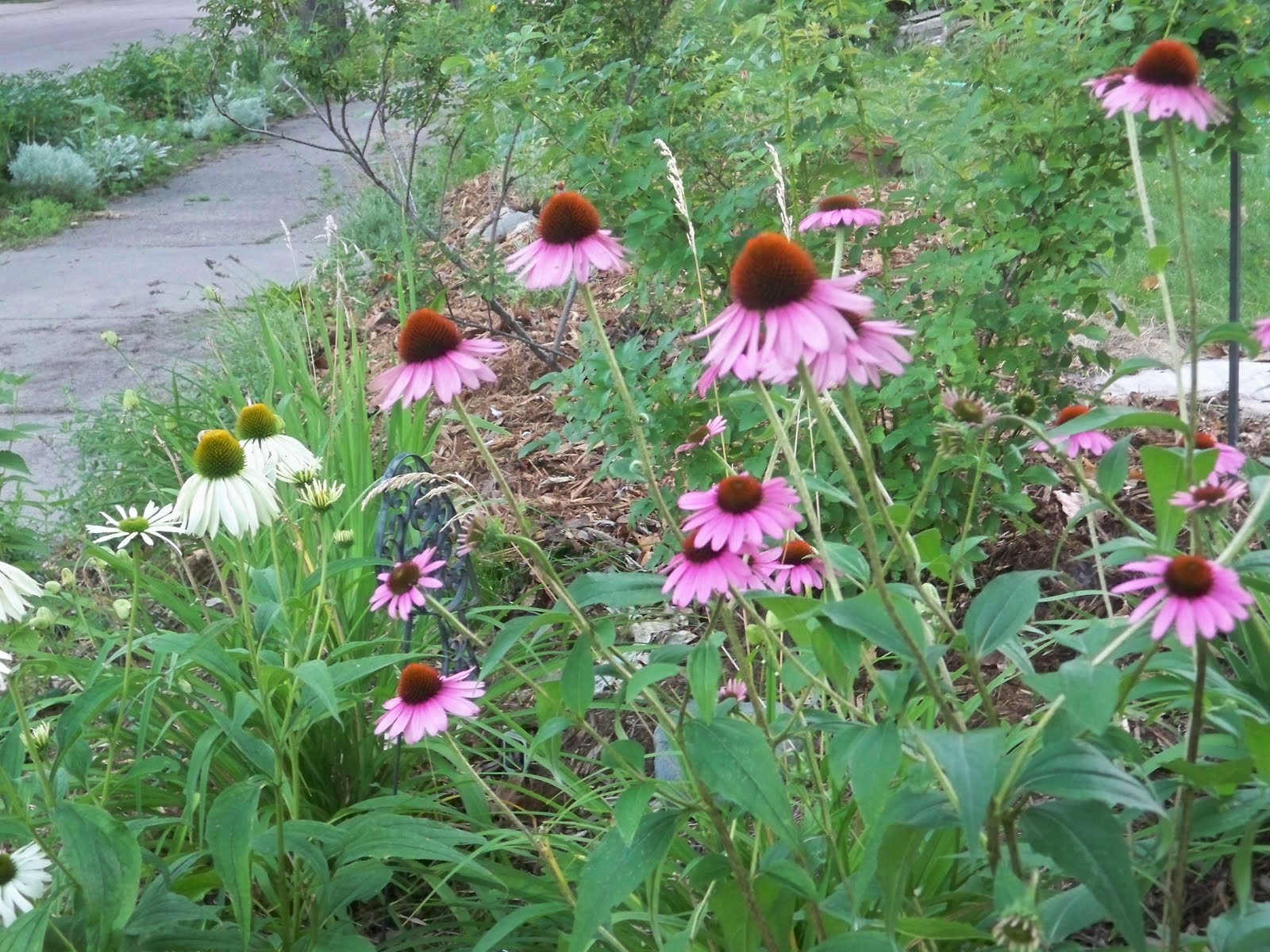
Most of the natives have started to pop, too: Purple Coneflower, White Swan Coneflower

Rudbeckia, Purple Garden Phlox, Russian Sage

And, my new favorite Ratibida with the Anise Hyssop.
Sunday, July 4, 2010
Productive Day in the Garden
Day Two of the Stay-cation was much more productive than Day One—even though we had temps in the 90s with dewpoints in the 70s. People were wondering whether this was Minnesota or Florida. My game plan was to work in the shade as much as possible for as long as possible and quit when it got unbearable.
I got two more monarda “Marshall’s Delight” planted in the Fragrant garden and moved the last “Magnifica” from the west side of the house to the Fragrant garden. I had gotten one Marshall’s Delight last year and I love the height and color of it. Adding the Magnifica gives me five roses in the garden and a deeper rose color to play off the monarda.

I added a juniper on the west hill. It’s tiny, but adds a different color and texture to the hill. The biggest part of that job was building up the rock wall to hold the soil.

After a passer-by (apparently a regular) asked Friday, “Are you ever going to plant these hostas?” I figured that should be my next project. So, I got the hostas planted on the west side of the front walk and moved the trollius in for some texture and color.
In the evening, I got the last rain barrel installed and stopped up the leaks on two others to get ready for the rain we were expecting (and did get this morning). There’s still more to do, so I’m feeling grateful for a few more days off. I think I’ll wait on the stone steps until the humidity drops, and will stick with planting and weeding until then.
Hope everybody has a safe and happy Fourth of July!
I got two more monarda “Marshall’s Delight” planted in the Fragrant garden and moved the last “Magnifica” from the west side of the house to the Fragrant garden. I had gotten one Marshall’s Delight last year and I love the height and color of it. Adding the Magnifica gives me five roses in the garden and a deeper rose color to play off the monarda.

I added a juniper on the west hill. It’s tiny, but adds a different color and texture to the hill. The biggest part of that job was building up the rock wall to hold the soil.

After a passer-by (apparently a regular) asked Friday, “Are you ever going to plant these hostas?” I figured that should be my next project. So, I got the hostas planted on the west side of the front walk and moved the trollius in for some texture and color.
In the evening, I got the last rain barrel installed and stopped up the leaks on two others to get ready for the rain we were expecting (and did get this morning). There’s still more to do, so I’m feeling grateful for a few more days off. I think I’ll wait on the stone steps until the humidity drops, and will stick with planting and weeding until then.
Hope everybody has a safe and happy Fourth of July!
Monday, June 28, 2010
Botanical Names and Common Names
“What’s that?” a neighbor asked the other day. “It’s a Lychnis Chalcedonia,” I answered, enthusiastically. She laughed and asked, “No, I mean, what’s its real name?!” I paused, thinking I had already told her the real name. She sensed my hesitation and asked, “What’s its street name?!” “Oh,” I said, “It’s a Maltese Cross.”
Even though I’m a language geek, I used to think that people who used botanical names for plants were snobs or show offs. After taking a botany class, however, I learned that botanical names provide a universal method of communication. I learned that common names vary from region to region, but botanical names are the same worldwide. An example is Aegopodium, which is called Snow on the Mountain, Bishop’s Weed, Gout Weed, and Ground Elder depending on the region you’re in. A guy told me Saturday he called Mondara “Firecracker flower” because they were blooming at the Fourth of July and they looked like exploding fireworks. Up to then, the only common name I’ve heard for Monarda is “bee balm.”
On the worldwide front, my aunt and I were “talking plants” last summer while I was visiting her in Norway, and she wanted to know if we had any Hortensia in the US. I didn’t recognize the name and asked if she could point it out to me. Turns out, the common name for Hydrangea in Norwegian is Hortensia.
So, if you stop by Auntie K’s Garden and ask what something is, I’ll likely use the botanical name for a plant rather than the or a common name.
Even though I’m a language geek, I used to think that people who used botanical names for plants were snobs or show offs. After taking a botany class, however, I learned that botanical names provide a universal method of communication. I learned that common names vary from region to region, but botanical names are the same worldwide. An example is Aegopodium, which is called Snow on the Mountain, Bishop’s Weed, Gout Weed, and Ground Elder depending on the region you’re in. A guy told me Saturday he called Mondara “Firecracker flower” because they were blooming at the Fourth of July and they looked like exploding fireworks. Up to then, the only common name I’ve heard for Monarda is “bee balm.”
On the worldwide front, my aunt and I were “talking plants” last summer while I was visiting her in Norway, and she wanted to know if we had any Hortensia in the US. I didn’t recognize the name and asked if she could point it out to me. Turns out, the common name for Hydrangea in Norwegian is Hortensia.
So, if you stop by Auntie K’s Garden and ask what something is, I’ll likely use the botanical name for a plant rather than the or a common name.
Tuesday, June 15, 2010
Natives
The city of Minneapolis offers a class on creating rain gardens and planting natives in your yard. I took it last year, not expecting much, frankly. I was pleasantly surprised not only by the quality of the content but also by the credentials of the presenter. I didn’t elect to plant a rain garden – I’m using rain barrels instead – but I did elect to plant some natives in all of my gardens and all natives in two of my gardens, including coneflowers, rudbekia, liatris, asters, monarda, and anise hyssop. The colors are fabulous and they attract birds, butterflies, and bees.
“What’s a Native?!” you ask. Well. A native is a plant that has its origins in your region. These are typically great plants because they will thrive with very little care. (Trust me on this one.) And, they’re typically resistant to pests. I don’t know a lot about natives in other regions, but in my region, the natives are an awesome way to get the water way down deep into the earth, which is where we want the water to go.
The most fascinating piece of information I learned from the rain garden workshop was that roots of native prairie plants are on average twice the depth as their height above ground. This means that if you have a plant that’s two feet tall, the roots will be at least four feet deep! And, a portion of the roots die off every year, leaving straw-like tubes for the water to run into, getting the water deep into the earth, reducing both runoff and erosion! How cool is that?!
And, lest you think that only prairie plants are native to Minnesota, here’s a list of natives for prairie, meadow, woodlands and wetlands from the University of Minnesota Extension service.
“What’s a Native?!” you ask. Well. A native is a plant that has its origins in your region. These are typically great plants because they will thrive with very little care. (Trust me on this one.) And, they’re typically resistant to pests. I don’t know a lot about natives in other regions, but in my region, the natives are an awesome way to get the water way down deep into the earth, which is where we want the water to go.
The most fascinating piece of information I learned from the rain garden workshop was that roots of native prairie plants are on average twice the depth as their height above ground. This means that if you have a plant that’s two feet tall, the roots will be at least four feet deep! And, a portion of the roots die off every year, leaving straw-like tubes for the water to run into, getting the water deep into the earth, reducing both runoff and erosion! How cool is that?!
And, lest you think that only prairie plants are native to Minnesota, here’s a list of natives for prairie, meadow, woodlands and wetlands from the University of Minnesota Extension service.
Subscribe to:
Posts (Atom)
